Neqet Yukaatkut. Niiciki Qanemciput.
We are Salmon People. Hear our stories.
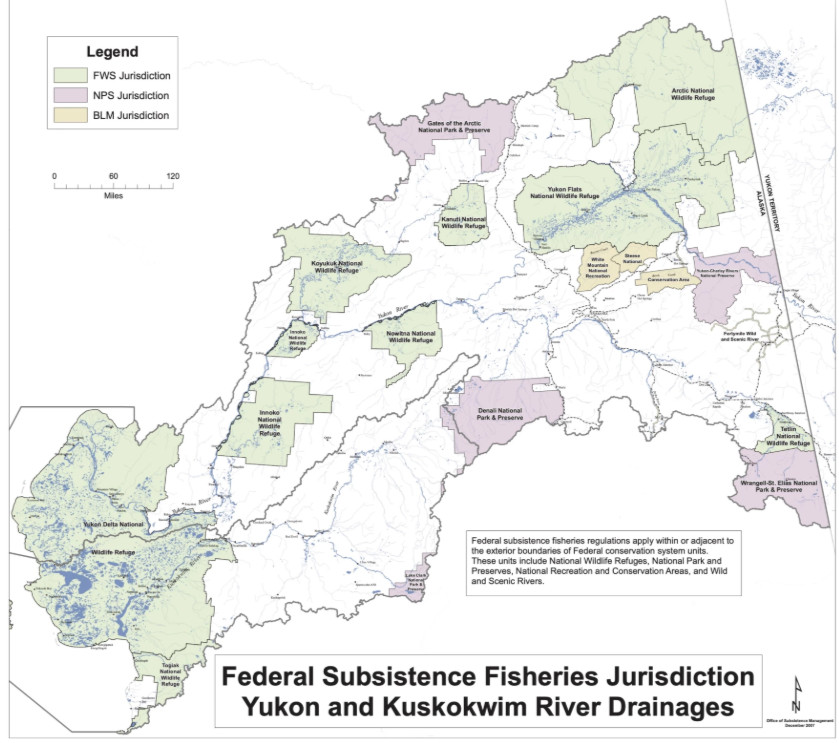
Yukon River salmon management has been fragmented for decades. Dual state-federal in-river management and indirect management of marine juveniles in the ocean both exclude and complicate engagement from Alaska Native communities and advocates.
Management Within the Yukon River
State management over state-owned lands and waters conflicts directly with federally directed management of fisheries on federal public lands, in part because of differences in how subsistence users are defined.
According to Title VIII, Section 804 of the Alaska National Interest Lands Conservation Act, “the taking on public [read: federal] lands of fish and wildlife for non-wasteful subsistence uses shall be accorded priority over the taking on such lands of fish and wildlife for other purposes.” Additionally, ANILCA defines subsistence on federal lands and waters as an activity of rural Alaskan residents, while state law views subsistence as an activity by all Alaskan residents. Fragmentation of state and federal management, challenges cohesive fisheries management throughout the Yukon River drainage and divides our families from those who live in urban (nonrural) areas from those who still live in the village.
Yukon River salmon management is further complicated by international law –– specifically, the Pacific Salmon Treaty. Sustainably managing Yukon River Chinook and chum salmon entails accounting for not just Alaskan’s escapement goals and subsistence needs, but those of Canadian people and First Nations, too. Assessments and management recommendations for Yukon River salmon of Canadian origin are made by the bi-national Yukon River Panel.
Despite the many entities involved in Yukon River salmon management, there are no collaborative salmon management agreements with Alaska Native Tribal governments of the Yukon River, meaning our leaders and communities are disenfranchised from making decisions about our fisheries despite evidence that Alaska Native people have depended upon and sustainably managed Yukon River salmon stocks for at least 11,800 years. This is just what happened in 2024, when the Alaska Department of Fish and Game as well as Fisheries and Oceans Canada both signed an agreement for a seven-year moratorium on the harvest of Yukon River Chinook salmon, without involving or even consulting with Alaska Native Tribes.
Yukon River fishing families and Tribal governments face these kinds of issues because of fragmented fisheries management:
- Confusing, inconsistent, and shifting rules on the same river
- Different eligibility rules for fishing
- Enforcement uncertainty leading to harassment and harsher regulation overall
- Erosion of Indigenous Self-Governance in the wake of top-down management
- Bearing the cost of fishery depletion and disproportionate burden of conservation with no managerial accountability
- Management actions are not translated into local languages
These lead to very real consequences for our fishing families and communities:
- Accidental regulatory violations leading to monetary fines or property seizures
- Tribal sovereignty and the responsibility Tribal governments have to the wellbeing of their Tribal citizens is ignored or dismissed
- Humanitarian food security crisis with resulting health consequences, such as increased rates of diabetes and suicide, because of multiple years of salmon fishing closures
- Double the effort and cost to advocate for customary and traditional subsistence fisheries, which are supposed to have a priority over other types of fishing, leading to redundancy and higher costs to our people and communities to share our Indigenous Knowledge in the hopes of influencing regulatory decision-making and fisheries management
- Whole families and villages are prevented from practicing our way of life by subsisting on salmon
Out at Sea
Yukon River Chinook and chum salmon spend most of their lives in the North Pacific Ocean, particularly the Bering Sea. Yet the management entities responsible for at-sea fisheries that impact Yukon River salmon fail to take accountability for responsibly and sustainably managing them –– and as our Tribes experience in-river, there are no designated seats at the tables for our Tribal leaders.
Within three nautical miles of the Alaska coastline, juvenile Yukon River salmon fall under the jurisdiction of the Alaska Department of Fish and Game. Typically, they are managed as resources available for extraction by commercial fisheries, as is the case in the South Alaska Peninsula, better known as Area M. Despite statues and policies spelling out the State’s subsistence priority and commitment to sustained yield of fisheries, Yukon River communities have seen their subsistence harvests closed while Area M’s harvest of intercepted salmon, including those returning to the Yukon and other Alaskan rivers, is prioritized for commercial profit.
From three to 200 miles offshore, juvenile and adult Yukon River salmon are managed by the North Pacific Fishery Management Council — not as species targeted for harvest, but as bycatch “necessary” for the profit pursuit of pollock trawl fisheries. When Yukon River communities demand the Council or the federal agency, NOAA Fisheries, take action to manage our salmon in more sustainable ways, we are told they have no responsibility to do so except to reduce bycatch “to the extent practicable” for trawling to continue without risking the annual total allowable pollock catch and the trawl industry’s profits. Instead, NOAA Fisheries points us back to the State of Alaska as the principal salmon manager. When we ask for a seat at the table to help steer trawl nets away from our salmon, we are directed to the U.S. Congress to change the Magnuson-Stevens Fishery Management and Conservation Act, knowing full well that Alaska’s congressional delegation is well-funded by the pollock industry.
A Tribally Led Ocean-to-Smokehouse Cycle
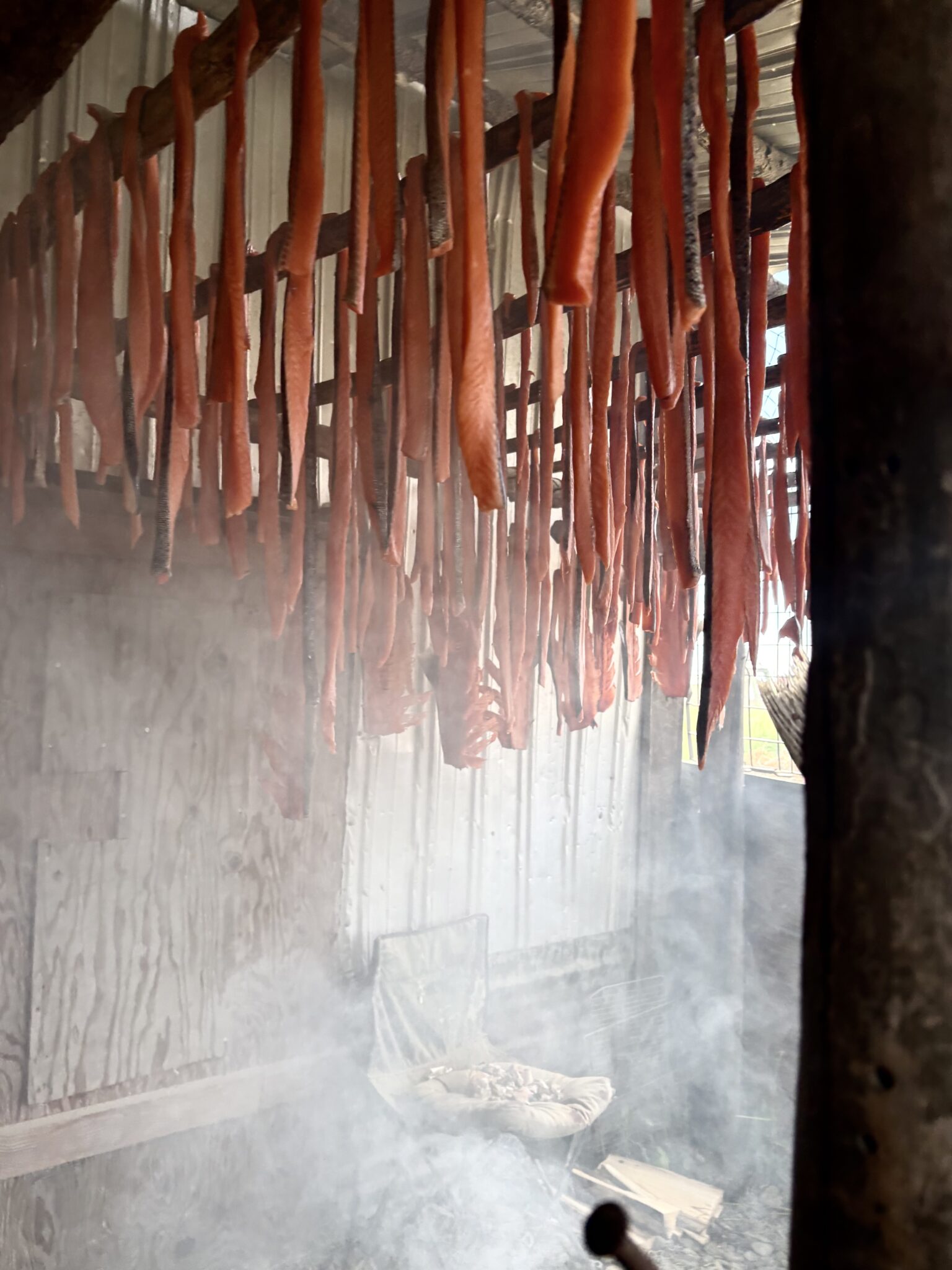
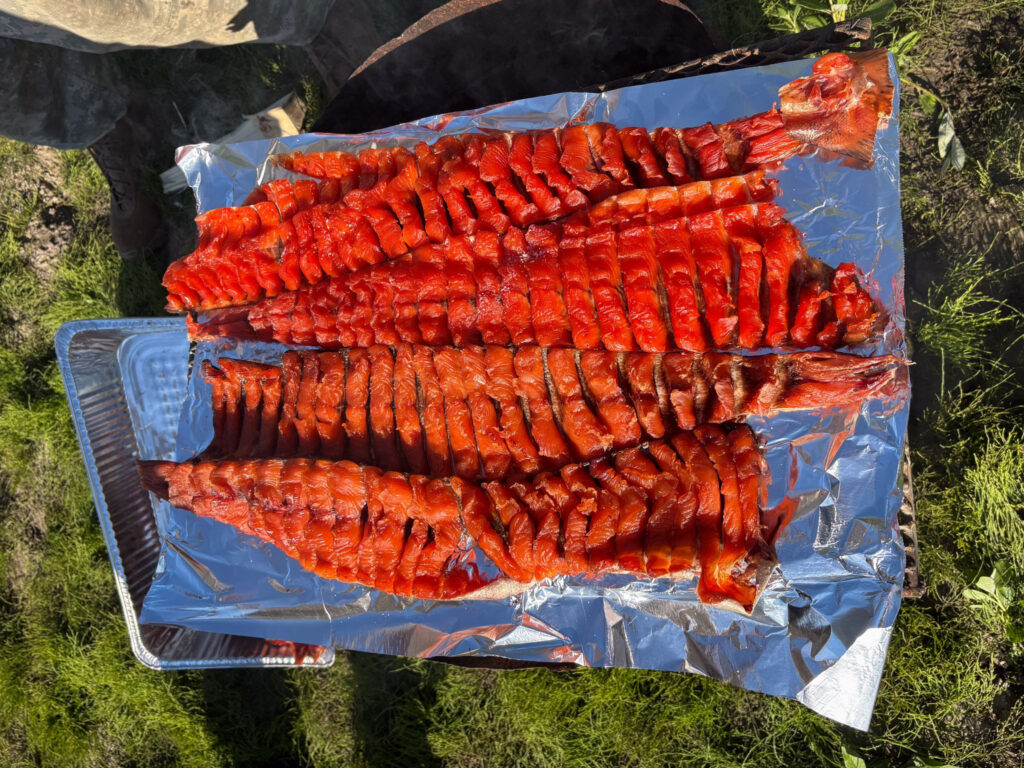
Yukon River fishers have been advocating for years to solve the harmful and persistent problem of management fragmentation to reduce the burden on Yukon River community members. In order for our Yukon River salmon to return in greater numbers and for our fisheries to thrive, we need a Tribally led, Ocean-to-Smokehouse Cycle management framework. Otherwise known as gravel-to-gravel stewardship, this framework thinks of managing salmon not as divided jurisdiction sections, but through a unified, ecosystem-wide management system led by regional Tribes, which sees protecting salmon in the ocean is just as important as caring for salmon in our rivers and in our smokehouses. This Ocean-to-Smokehouse Cycle framework is centered on fostering subsistence communities, uplifting our Elders’ knowledge, and protecting Our Ways of Life.
It is time to shift away from unsustainable, fragmented management systems that leave Alaska Native knowledge, Tribal stewardship values, and leadership out of the equation. When local, state, and federal fisheries management systems of fisheries are streamlined, and when Tribes and our knowledge of salmon are leading management strategies, all Alaskans thrive.
If the fragmented systems are connected by and through our Tribes, then our salmon can travel from ocean to smokehouse, and from gravel back to gravel. Every salmon counts.

